Flight report · July 24, 2026
Flight 13: Starship’s first intact water landing
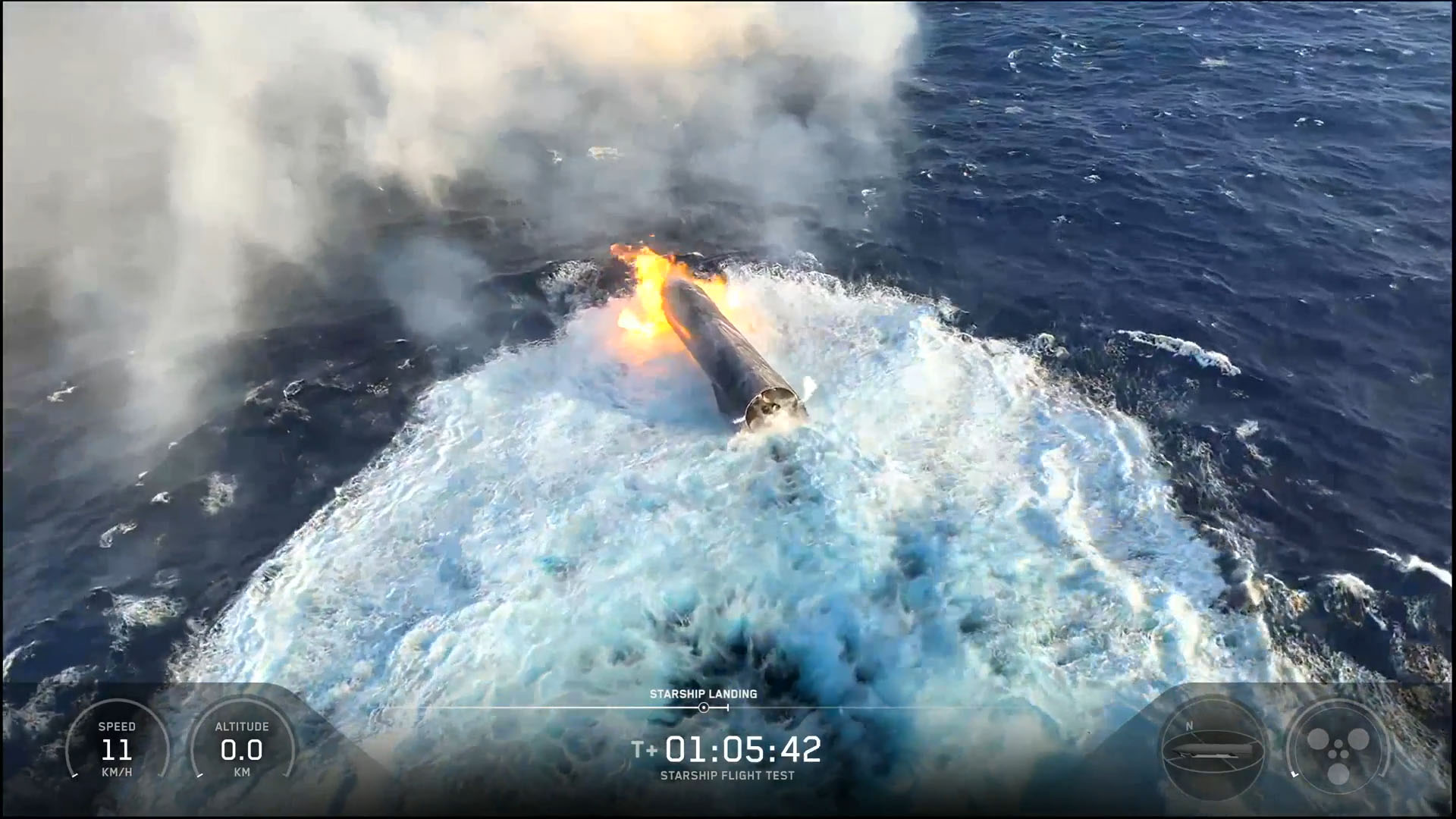
Ship 40 soft-splashed in the Indian Ocean and floated while still returning imagery, a first for the program. Super Heavy hard-splashed after a partial landing burn.
Starship V3 · Orbital Launch Pad 2 · Flight 13 of 14
Outcome
Ship floated intact / booster hard splashdown
- Ship
- Ship 40Success
- Flown · At sea · aboard Forte (Texas-bound)
- Booster
- Booster 20Partial
- Lost · Lost on flight
Key figures
- Liftoff
- 5:51 p.m. CT · Jul 24
- Pad
- Orbital Launch Pad 2
- Payload
- 20 Starlink V3
- Ship result
- Intact float
01 / 05
The flight
What happened
SpaceX flew Starship’s 13th integrated test on July 24, 2026 from Starbase Pad 2. It was the second flight of the V3 stack, and the first time a Starship soft-splashed, tipped over, and remained intact on the water instead of breaking up or catching fire.
The company treated the intact float as a heat-shield data windfall: onboard cameras kept transmitting, recovery drones imaged the vehicle, and SpaceX called the outcome a dream case for teams studying tile and thermal performance.
02 / 05
Ascent and payload
After a July 16 abort and a weather slip, the stack cleared the pad on the July 24 attempt. Ascent on Booster 20 looked strong, with the high-thrust portion of boostback using the full Raptor set for the first time on a V3 booster.
Ship 40 then deployed 20 Starlink V3 satellites on the suborbital profile. They were functioning satellites rather than inert mass simulators. The ship completed an in-space Raptor relight before heading into reentry.
03 / 05
Ship recovery
Reentry stressed the heat shield on a higher-dynamic-pressure profile. Visible tile loss stayed low. Where tiles came off, the underlying ablative layer appears to have protected the structure.
About 65 minutes after liftoff, Ship 40 executed a powered soft splashdown in the Indian Ocean west of Australia. Residual propellant briefly burned on the surface, then went out. The ship floated and kept returning imagery. It was the program’s first intact water landing.
04 / 05
Booster return
Super Heavy was not catching on this flight. It targeted a controlled Gulf of Mexico splashdown that still needs a clean landing-burn sequence before another tower catch attempt.
Landing burn ignition was incomplete: fewer Raptors lit than planned, and the booster hit the water harder than intended. That leaves booster soft-splash reliability as open work heading into Flight 14.
05 / 05
What it means next
Flight 13 closes a major ship-side gate: prove the vehicle can survive reentry and land intact enough to study. Heat-shield data and Starlink V3 deployment both moved the campaign forward.
Ship 40 left Christmas Island aboard Forte on August 28. NASASpaceflight reports Forte is in the Atlantic with a Texas arrival no earlier than October 8. Two tiles removed from Ship 40 flew on Ship 41 during Flight 14, which reached orbit on September 28.